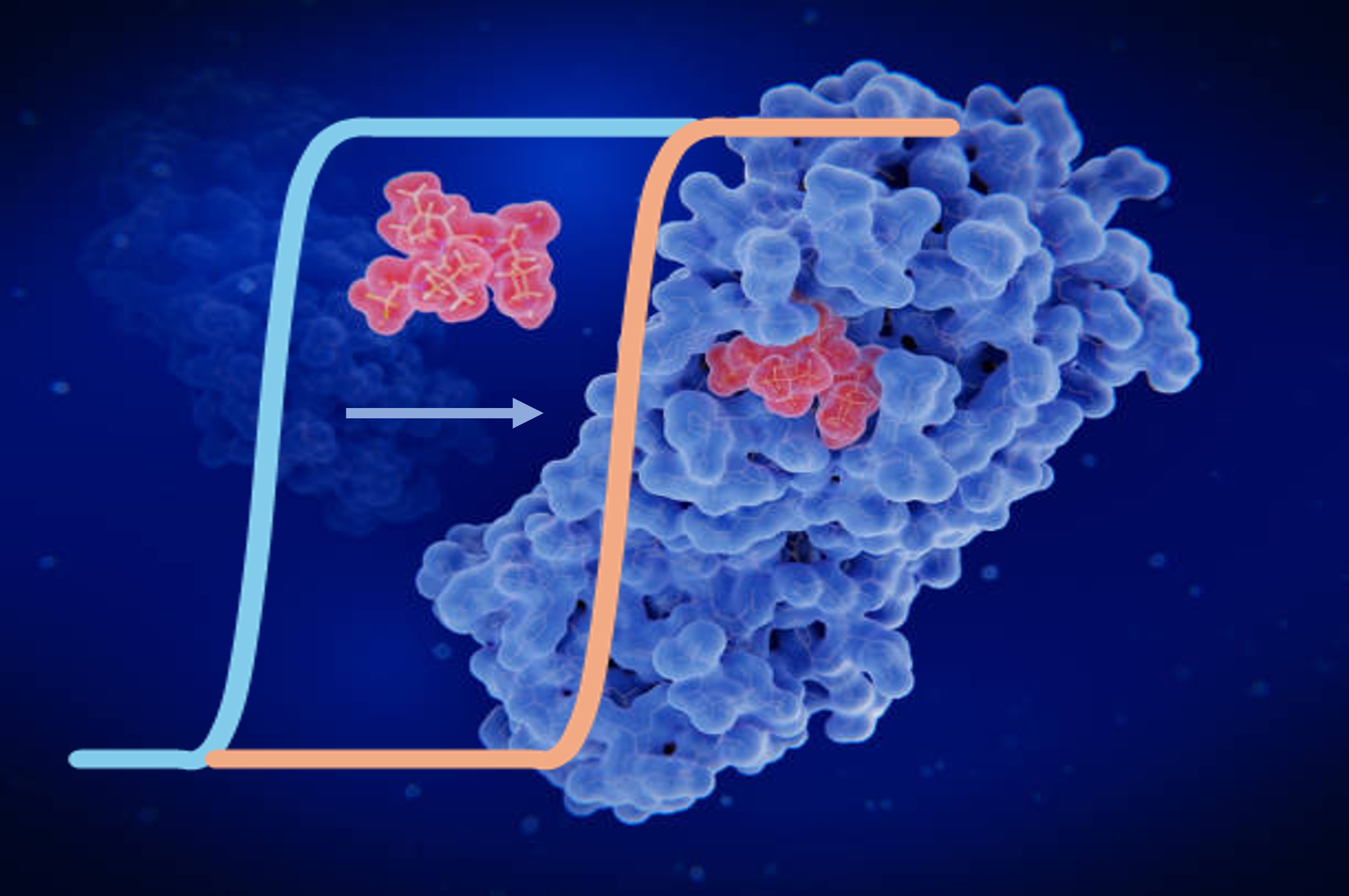
Protein-Ligand Interaction Assay
External label FRET-Probe binds to denatured protein structures leading to high TR-FRET signal. Ligand binding stabilizes the protein structure and thermal shift is monitored.
Aggregation and Formulation Assay
Lanthanide-chelate based external label binds to aggregated/denatured protein structures and high TRF signal is measured. Non-bound Ln-probe is quenched in the detection solution.
Protease Assay
Lanthanide-chelate external label binds to protein structures providing high TRF signal. In case, target protein is digested due to protease activity, the Ln-probe is incapable of binding to the digested target and quenched in the detection solution.
Virus Counting
Lanthanide-chelate probe binds to virus structures leading to high TRL signal. Non-bound Ln-probes are quenched in the detection solution. Both enveloped and non-enveloped viruses can measured.
Protein-Probe™ technology is design for ultra-sensitive detection of proteins and variations in protein stability. The probe technology can be further applied to protease activity and virus particle counting. Successful Protein-Probe assays are based on carefully peptide-probe design and case dependent modulator buffer design.
Our technology for protein stability, aggregation, and storage formulation monitoring is based on the Protein-Probe™ technology using the developed external peptide-probes. The method is based on time-resolved fluorescence (TRF) readout, providing simple, homogeneous and high throughput compatible assay format. A proprietary assay buffer modulates TRF-signal enabling direct measurement for defining optimal storage formulations for proteins and for screening of compounds that promote or inhibit protein aggregation or (thermal) stability. The FRET-Probe™ is an excellent candidate to protein-ligand interaction (PLI) studies.
Unlike other protein aggregation assays, mostly based on Thioflavin T and its variants, the Protein-Probe™ technology utilize peptide-probe and assay buffer modulation. This approach enables nanomolar sensitivity for antibody aggregates and significantly lower material consumption in comparison to existing technologies. In a typical assay, few microliters of sample are needed for the detection, and the optimized assay buffer will make the assay robust without interferences from the protein storage buffer. In addition, the Protein-Probe™ technology protein (thermal) stability screening, suitable for differential scanning fluorimetry (DSF) type inhibitor screening, using only low nanomolar protein concentrations and TRF readout.
Our Protein- Probe™ technology products also extend to protease activity testing and virus particle counting. The external peptide-labels probe substrate proteins without any substrate modifications widening application scale to investigate intact protein substrates at nanomolar concentration range. The virus counting method provides virus particle counting for enveloped and non-enveloped viruses even below 100,000 particles in a high throughput assay format.
The Protein-Probe™ technology is design for ultra-sensitive detection of proteins, protein binders such as small molecule sand variations in protein stability. The probe technology can be further applied to protease activity and virus particle counting. Successful Protein-Probe assays are based on carefully peptide-probe design and case dependent modulator buffer design.
Protein-Probe Assay kits
|
Product code |
Protein-Probe Protein-Ligand Interaction assay kit |
PLA QTK-400 |
Protein-Probe Aggregation assay kit |
PAA QTK-400 |
Protein-Probe Formulation assay kit |
PFA QTK-400 |
Protein-Probe Virus count assay kit |
PVC QTK-400 |
Protein-Probe Protease assay kit |
PPR QTK-400 |
Scientific reports:
Luminophore Chemistry for Detection of Urinary Bladder Cancer – Comparison to Cytology and Urinary Rapid Tests (BTA stat®, NMP22® BladderChek® and UBC® Rapid Test)
Thermal Shift Assay for Small GTPase Stability Screening: Evaluation and Suitability
Rapid high-throughput compatible label-free virus particle quantification method based on time-resolved luminescence
Protease Substrate-Independent Universal Assay for Monitoring Digestion of Native Unmodified Proteins
Sensitive, homogeneous, and label-free protein-probe assay for antibody aggregation and thermal stability studies
Sensitive Label-Free Thermal Stability Assay for Protein Denaturation and Protein–Ligand Interaction Studies
Nanomolar Protein–Protein Interaction Monitoring with a Label-Free Protein-Probe Technique